
A Once-in-a-Generation Opportunity
The Grand Trunk Railway (GTR) redevelopment is a once-in-a-generation opportunity to breathe new life into one of Stratford’s most historic but long-underused places.
NEW!
Download the Public Q&A (PDF Download) >>
Download the Detailed Cost Comparison (PDF Download) >>
Download the Master Spreadsheet (PDF Download) >>
Download the Public Statement (PDF Download) >>
The redevelopment of the GTR site is grounded in years of public process, technical study, and community discussion. Building on the 2018 Master Plan, structural engineering reports, and extensive input from residents and stakeholders, the proposal approaches the site not as a blank slate, but as a place shaped by history, investment, and real constraints. Rather than restarting the conversation, it builds on what the community has already asked for, while responding to what has changed.
At the centre of the proposal is the existing locomotive repair shop, a nationally significant heritage structure that has often been viewed as a liability. This redevelopment reframes the building as an asset. Past structural assessments indicates it can be rehabilitated at a known and manageable cost, while reuse avoids the far greater uncertainty and expense associated with full demolition and large-scale site remediation. By working with the building, the project reduces environmental disruption and preserves a powerful piece of Stratford’s industrial identity.
The proposed redevelopment focuses on community-first uses that support daily life in the city. By consolidating services such as a library, YMCA, childcare, community theatre, and flexible community spaces under one roof, the site becomes an active civic hub rather than a single-purpose development. An internal concourse connects these uses, encouraging accessibility, shared space, and interaction across generations and user groups.
A phased approach allows the project to move forward responsibly. Rehabilitation of the base building comes first, creating a stable framework that future users can build into as funding, partnerships, and grants become available. This flexibility reduces financial risk, allows development to adapt over time, and avoids an all-or-nothing decision.
Together, these strategies position the GTR site for a new chapter, one that respects its past, responds to present realities, and serves Stratford well into the future.
Looking for more detailed information on the GTR site and the proposed redevelopment? See below:
Download the latest full Open House presentation, revised March 2026
View the individual sections of the presentation:
How we get there: You build it in phases
Update: Can we still
get Locomotive 6218?
Update: Solar Panels
Update: The Area of Review – Affordable housing
Update: How to insulate and reface to
reflect the original facade
What we have: Building, Site, Debt
Environmental Factors
Can the GTR Building be Repurposed as Proposed?
Collaborate: Do Not Think in Silos
It’s a Chess Game: Effective asset management
It’s a Chess Game:
Before & After Slides of YMCA Repurposed into SPS HQ
The Completed Development: Site Plan & Elevations
Before & After Photos & Illustrations
Recap: Does the City need a developer?
Update: Proposed Site Plan and Street Changes
Update: Phasing
The Building is the Solution, Not the Problem
Development Options
Heritage Aspects: Heritage Canada the National Trust
Rehabilitate the Building
It’s a Chess Game: How to make it happen
It’s a Chess Game: Where we are at
“This project is too big for Stratford”
How we get there: Project Management
Update: Railway
Update: The Area of Review
Preservation & Challenges
View the latest update on if we can repurpose the building, revised March 2026
Preserving the GTR building has long been a central and sometimes contentious part of discussions about the site’s future. Over the years, proposals have ranged from institutional and community uses to private development, prompting important debate about whether the structure should be retained. Through public consultation and Council decisions, including the 2015 vote to preserve the building, the community affirmed its heritage value and its potential to play a meaningful role in Stratford’s future.
At the same time, the challenges are real. The site’s industrial history has left areas of contamination, and the scale of the building requires careful planning and investment. Estimates to rehabilitate the structure are significant, but they are known and measurable, particularly when compared to the far greater uncertainty and cost associated with demolition and full site remediation. Engineering and environmental studies indicate that working within the existing building substantially reduces remediation requirements and limits environmental disruption.
Since the 2018 Master Plan was adopted, circumstances have evolved. Public concern has grown around the more than $27 million already invested in the site, and some original partners, such as the university, have shifted their plans. At the same time, new and pressing community needs have emerged, including expanded recreational facilities, consolidated civic services, and affordable housing. These changes require a renewed approach, one that acknowledges past investment while adapting to current realities.
The preservation strategy responds directly to these challenges. By retaining the building and developing it in phases, the project reduces financial risk, allows flexibility over time, and creates opportunities for the building to help fund its own future. Rather than viewing preservation as an obstacle, the proposal treats it as a practical and responsible path forward, one that balances heritage, fiscal responsibility, and long-term community benefit.
.png)
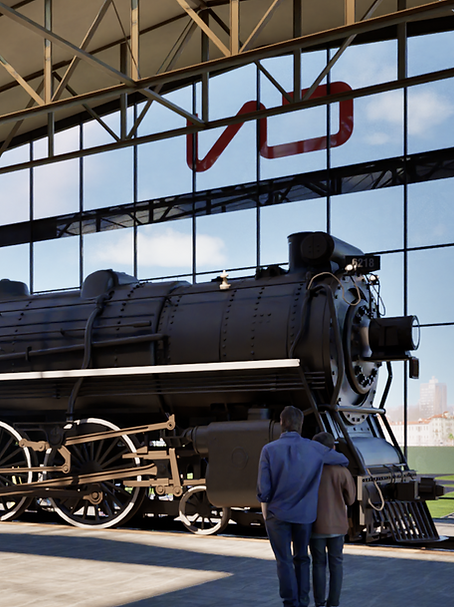
GTR Locomotive Repair Shop
View the latest update on Locomotive 6218, revised March 2026
Located on the south edge of Stratford, the former GTR Shop has been part of the city’s story since its earliest years. Built in 1907, the building was a remarkable feat of structural engineering and industrial design. At the time, it was the largest locomotive repair facility in Canada, defined by its 70-foot-wide by 50-foot-high bay supporting a 200-ton moving crane that reflected the scale and ambition of the railway era.
The facility ceased operations in 1963 as rail technology shifted from steam to diesel and later found new life supporting gas turbine manufacturing. When industrial use came to an end in the early 1980s, the City acquired the property, maintaining it as a parking area while its long-term potential was considered.
Today, the site stands as a powerful reminder of Stratford’s industrial heritage and a rare opportunity to reimagine a landmark structure, one that connects the city’s past to a new, community-focused future.